Small business owners in Greater Victoria are not standing still, and many work hard on their small business online presence. They know the market has moved online, and they have moved with it. They built a website. They opened a Facebook page and an Instagram account. Many now use ChatGPT to make images and write posts for their channels.
And yet, when WIZAD talks with these owners, the same quiet frustration comes up again and again: we are doing all the right things, so why isn’t it working?
The answer is rarely “do more.” Big impact comes from small wins: the right wins, delivered in the right order, all pointing at one goal.
Good strategy is choosing the right goal. Good execution is defining sprints along a prioritized roadmap.
A busy small business online presence, but few results
Canadian data tells the same story, and why digital transformation stalls in small businesses is rarely about the tools themselves. In a February 2026 survey of 1,500 business owners, BDC found that almost every small and medium-sized business is investing in digital tools, but few have turned that investment into a mature, connected way of working.
Look closely at a typical small business online, and three problems tend to show up together.
Low resultsFew likes, comments and messages. Fewer bookings and orders. Visitors arrive, look around and leave without taking the next step.
Scattered customersEnquiries come in through the website form, Facebook messages, Instagram DMs, email and the phone. Nobody has the full picture, so follow-ups slip and returning customers feel like strangers.
Stale channelsA website that hasn’t changed in a year. A Facebook page with old hours, last season’s prices or a menu that no longer exists.
Stale channels cost more than they seem to. Online platforms reward businesses that stay current and active. Google says local search results are based mainly on relevance, distance and prominence, and it advises businesses to keep their information complete and up to date and to respond to reviews. Facebook’s feed is ranked by systems that predict how likely each person is to engage with a post. A page that rarely changes and rarely gets interaction slowly becomes harder to find.
None of this happens because owners don’t care. It happens because they run the business first and the channels second. With no spare people and no spare hours, a channel that doesn’t seem to pay off gets left alone, and owners focus on the one or two that still seem to work. That is a reasonable choice in the moment. Over time, it means missed customers, missed bookings and missed opportunities.
Why more effort isn’t the answer
The usual response is to try harder: more posts, more AI-made images, another platform. But more activity on a weak foundation gives more of the same results. A beautiful post doesn’t help if the website it links to has the wrong hours. A new message channel doesn’t help if nobody can see all the enquiries in one place.
What is missing is not effort. It is a clear goal, and an order in which to fix things.
AI works only as well as the strategy behind it
AI tools can save small businesses real time. BDC found that SMEs using generative AI are 24% more productive, yet only about three in ten use it. But AI only does what it is asked. Without a strategy, it produces more posts and more images that point nowhere in particular. The content looks fine, yet it doesn’t speak to the right customers, doesn’t connect to the rest of the business and doesn’t lead anyone to book or buy.
AI becomes truly effective when it has three things behind it:
- A good strategy. A clear goal, so every piece of content and every tool serves the same purpose.
- A clear background. Who the business is, what it offers, who its customers are and what makes it different.
- Deep context. What customers ask, what they worry about, what competitors do and what has worked before.
With all three, AI can help shape connected strategies across the website, social media, customer messages and follow-ups, so each channel supports the others and the effort adds up to results.
Good strategy: choose the right goal
Strategy is not a longer to-do list. It is a decision about what matters most. At WIZAD, that decision is the Zenith Goal: the summit the business wants to reach, written in one sentence that is specific, measurable and owned by the owner.
“Be more active on social media” is a wish. “Turn our online channels into 20 more bookings a month by spring, without adding staff” is a goal. It tells you what to measure, and which channels and tasks matter most. Once the goal is right, everything else sorts itself into two piles: “helps us get there” and “not now.”
Good execution: sprints on a prioritized roadmap
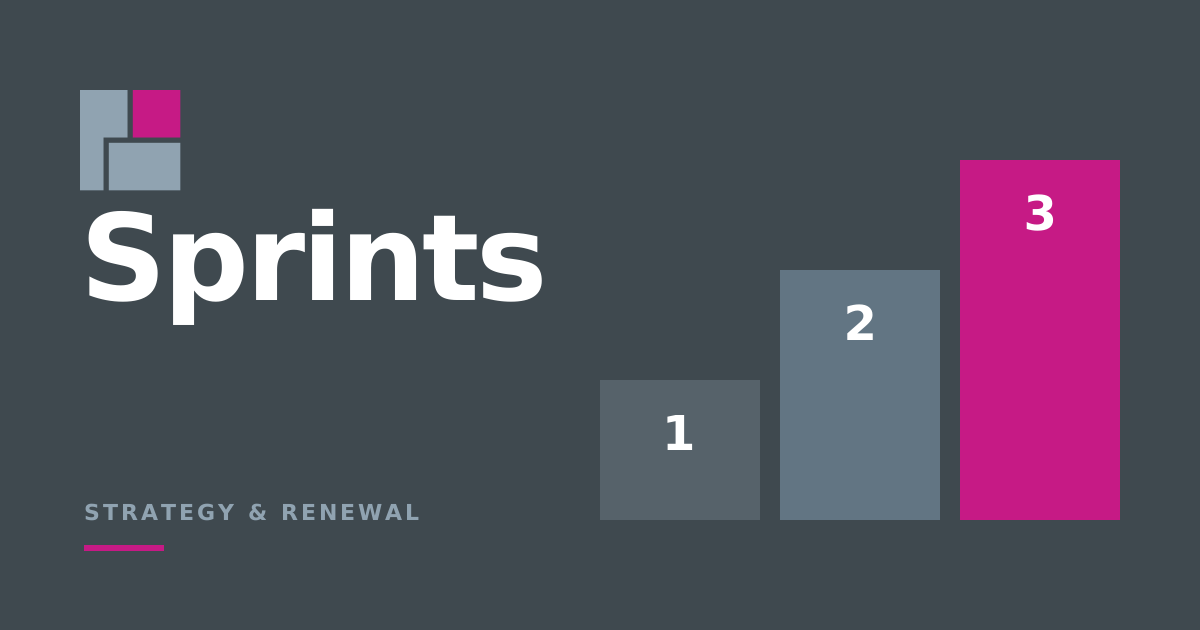
With the goal set, the next job is to cut the path to it into sprints. A sprint is a short, focused block of work with one clear outcome. It ends when something works and is in use, not when a report is written.
The order matters as much as the content. WIZAD puts first the sprints with the biggest impact on the goal, the lowest effort for the team, and the strongest foundation for what comes next. The first sprint is the quick win that proves the approach and builds the energy for the next one.
Who WIZAD helps
WIZAD works with owner-led businesses in Greater Victoria where the online experience shapes whether a customer walks in, books or calls. Five groups come up most often.
Coffee shopsHours, menus and photos change often, and regulars follow on Instagram. Out-of-date information quietly sends people elsewhere.First win: fresh, consistent listings everywhere.
RestaurantsReservations, takeout and delivery orders arrive through many apps and channels, and reviews shape every new visit.First win: one clear way to book or order.
Nail spasBookings come in through calls, DMs and walk-ins, and no-shows hurt a full schedule.First win: easy online booking with reminders.
Law firmsClients search carefully and compare firms before they call. A dated website and slow replies cost trust.First win: clear service pages and a fast enquiry process.
Immigration servicesClients have urgent, detailed questions, often in more than one language, across many channels.First win: one inbox and helpful answers to common questions.
How WIZAD helps
WIZAD starts by looking at a business’s online presence the way a customer would, then compares it with what is working elsewhere.
Step 1Assess every channelWebsite, Google Business Profile, Facebook, Instagram, reviews and how enquiries are handled.
Step 2BenchmarkCompare with leading businesses in the same industry and with local competitors in Greater Victoria.
Step 3Flag the serious issuesName the few problems that cost the most customers right now.
Step 4Build the roadmapRecommend step-by-step improvements as sprints, in priority order.
Starter sprints that make a difference
Every business is different, and the roadmap follows its Zenith Goal. Still, many small businesses benefit from a similar set of starter sprints. Each one is short, useful on its own and builds on the one before. For a real example of this approach, see how a Victoria real estate team rebuilt its operations in three sprints.
Notice what is not on the list: a brand-new website, a new platform or a big software project. Most businesses already have the channels they need. The quickest gains come from making those channels current, connected and easy to act on.
Even the first sprint pays off. According to Google, people who find a complete Business Profile on Search and Maps are far more likely to trust, visit and buy from that business.
Why small wins add up
A small win is not a small result. It is a finished step the team can see and use. Harvard researchers Teresa Amabile and Steven Kramer found that, of everything that lifts people’s motivation during a workday, the most important is making progress in meaningful work, even small progress. Small wins also bring practical gains:
- Momentum. The owner and the team see progress, and belief in the plan grows.
- Learning. Each sprint shows what works for this business and its customers, so the next one is better aimed.
- Time and cash. An early win often frees hours or brings in revenue that funds the next step.
- Lower risk. If something doesn’t work, you have lost one sprint, not a year.
A quick self-check
How many of these can you tick today?
- My website and Google Business Profile have been updated in the last three months.
- My hours, prices and services are the same on every channel.
- All customer enquiries end up in one place my team can see.
- I know how many enquiries turned into bookings or orders last month.
- Every channel gives customers one clear next step.
If you ticked fewer than three, your business probably has quick wins waiting.
Ready for your first small win? Leave your details, and Leo will assess your online channels and propose a winning roadmap for your business. No pressure, and no fee for the assessment.
Sources
- BDCA $350B opportunity: Canada’s next phase of growth to be driven by AI and digital technologies (June 2026)
- Google Business Profile HelpAbout Business Profile: why a complete profile matters
- Google Business Profile HelpHow to improve your local ranking on Google
- Meta Transparency CenterFacebook Feed AI system
- Harvard Business ReviewTeresa M. Amabile and Steven J. Kramer, “The Power of Small Wins” (May 2011)